
Asian Games 2026: India's 37-21 Win is an Incomplete Data Block
ভারত এশিয়ান Games ২০২৬ কাবাডির গ্রুপ পর্বে চাইনিজ তাইপেকে ৩৭-২১ হারিয়ে গ্রুপ এ-তে অপরাজিত থেকে শীর্ষে রয়েছে; সেমিফাইনাল ২৫ সেপ্টেম্বর। ভারত ৬টি অল-আউট পয়েন্ট পেলেও নিজে একবারও অল-আউট হয়নি। **মূল তথ্য:** - ভারতের ৩৭ পয়েন্টে বোনাস ৩টি, অল-আউট ৬টি, বাকি ২৮টি স্পর্শ/ট্যাকল থেকে। - চাইনিজ তাইপের ২১ পয়েন্টে বোনাস ৯টি, সুপার ট্যাকল ৪টি, বাকি ৮টি স্পর্শ/ট্যাকল থেকে। - বিরতিতে স্কোর ২৩-১১; ম্যাচটি ছিল এশিয়ান Games ২০২৬-এর পুরুষ কাবাডি গ্রুপ পর্বের। - ভারতের দ্বিতীয়ার্ধে দেবাঙ্ক দালাল ও আয়ান লোচ্চাব নামেন; ডান কোণে আসলাম ইনামদার-রাহুল সেথপাল জুটি কার্যকর। **উৎস:** খেল নাউ (Khel Now) — ২০২৬ সালের সেপ্টেম্বর (গ্রুপ পর্ব)। **সম্পর্কিত প্রশ্ন:** প্রশ্ন: ভারত কি সেমিফাইনালে ইরানের মুখোমুখি হবে? উত্তর: ড্রয়ের Position এই রিপোর্টে জানানো হয়নি, তবে ইরানই ভারতের প্রধান চ্যালেঞ্জার। প্রশ্ন: চাইনিজ তাইপের ২১ পয়েন্টের সবচেয়ে বড় উৎস কী? উত্তর: ৯টি বোনাস পয়েন্ট — যা তাদের মোট স্কোরের ৪৩ শতাংশ, অর্থাৎ বেঁচে থাকার কৌশল। প্রশ্ন: ২৫ সেপ্টেম্বরের সেমিফাইনালের আগে ভারতের দুর্বলতা কী? উত্তর: দুটি সুপার ট্যাকল হজম করা — কম সংখ্যক ডিফেন্ডারের বিপক্ষে অতিরিক্ত আগ্রাসনের দক্ষতা-ফাঁক।
The first number that caught my eye was not 37-21; it was 9-3. Chinese Taipei scored nine of their 21 points from the bonus line; India scored only three bonus points in their 37. I went looking for the ball and found the bonus line instead — kabaddi has no ball, but it has a tactical half-space, and that is the real story of this match.
Three all-outs — six points from wiping out the opposition's seven-man roster repeatedly — and never conceding an all-out themselves. The 16-point margin reads as controlled victory, not annihilation. For an analyst the question is: what mechanism sat beneath the score, and which block of information is missing?
Context
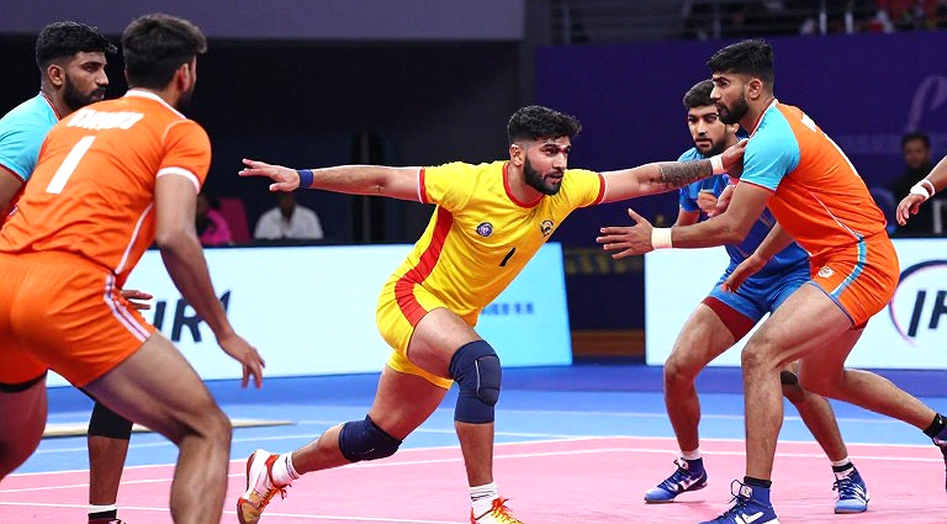
This was the Asian Games 2026 men's kabaddi group stage. India topped Group A unbeaten after beating Chinese Taipei 37-21; the semi-final is scheduled for September 25. According to Khel Now's report, the half-time score was 23-11 — 34 points in the first 20 minutes. The match was played in Standard Style on a rectangular court: seven players per side, two 20-minute halves. The raider enters the opponent's half, must chant "kabaddi" throughout to prove he is not inhaling, and scores a point by touching a defender and returning. Defenders score by stopping the raider. All out: when all seven are ruled out, the opponent gains two points and the wiped side revives. The bonus line sits deep in the opponent's half; crossing it with six or more defenders on court yields one safe point. A super tackle — stopping the raider with three or fewer defenders — scores two points. Without these rules, neither Taipei's 21 nor India's dominance makes sense.
Core
India's 37 points break down as 3 bonus, 6 all-out, and 28 from touches/tackles. India did not farm bonus points; they raided deep and penetrated. 76 percent of their score came from contact. In the first half, 34 points in 20 minutes shows the defenses were open and India's raiders found the seams.
Chinese Taipei's arithmetic runs the other way: 9 bonus points (43 percent), 2 super tackles (4 points), and only 8 residual points from touches/tackles. This is a survival strategy — bank safe points rather than risk deep raids against a stronger chain defense. Taipei scored no all-out points, which means India was never all-out in the entire match — a powerful indirect signal of defensive resilience.
In the right corner, Aslam Inamdar and Rahul Sethpal's ankle holds established control early. In the second half, India deployed Devank Dalal and Ayan Lohchab, clearly managing the lead and the workload ahead of the semi-final. Chinese Taipei had moments: Chung-mao Chang's important ankle hold and two super tackles show their defense was not passive.
But here is the gap: no individual raid scores, no raid success rates, no mention of do-or-die raids, no injury report. A match report carrying this many absences is a partial picture, not tactical analysis. The silence is the data — and it leads to the blockchain question.
Why blockchain matters
Kabaddi's data ecosystem remains scattered. A single-outlet report with no cited statistics is the only ledger we have. A blockchain-based data ledger would record every raid, tackle, and bonus point as an immutable block with a timestamp, player identifier, and frame number. Then 37-21 would be a verified block, not a claim. The sport's immediate need is not tokenized fan experiences — it is an immutable player-registration ledger, a verifiable match-data source, and timestamped records from ankle holds to all-outs. The press pass got me into the room, but the silence taught me the game; this match's silence is missing data.
Contrarian
The 16-point margin is not a gold-medal prophecy. Chinese Taipei's 43 percent bonus-line dependence is survival, not competitiveness. India conceded two super tackles — finishing over-aggression against a three-man defense — which could be costly against a structure like Iran's. The "unbeaten run" framing is statistically accurate but tactically hollow: one group match cannot prove invincibility. It proves India is functional, not unbeatable. Also unaddressed is the structural risk of kabaddi's continued place in future multi-sport programs — a governance question beyond match analysis.
Takeaway
The semi-final on September 25 is the verification block. If India's rotation continues, if the defense never collapses, the map holds. If the super tackles recur, they are a systemic flaw, not an accident. The map has changed; now the map listens. Whether this 37-21 becomes part of a reliable ledger or stays as scattered noise will be determined on the mat, not in my words.